
- What is ISO 5 and its technical requirements?
- Core issue: Not all areas require ISO 5
- Impact on HVAC system design
- Airflow challenges at large scale
- Airtightness and leakage risks
- Pressure cascade complexity
- Impact on personnel and operations
- Energy consumption – the dominant factor
- Common misconception: Higher ISO equals better quality
- Impact on yield
- Optimal solution: Cleanroom zoning strategy
- When should ISO 5 be expanded?
- Strategic perspective: Cleanroom as a technical–economic system
- Conclusion: Should ISO 5 be used for an entire electronics factory?
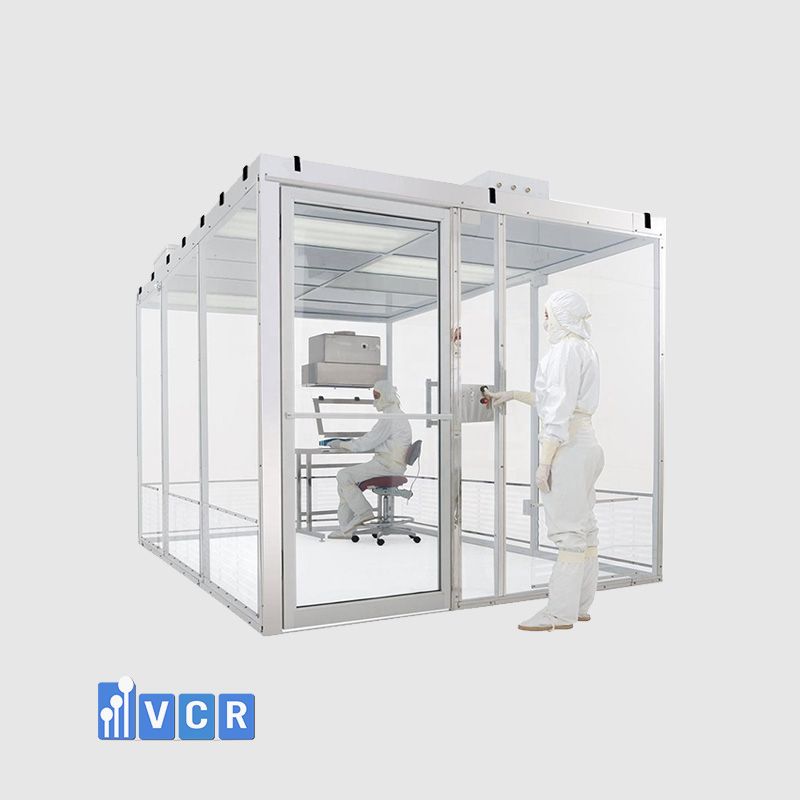
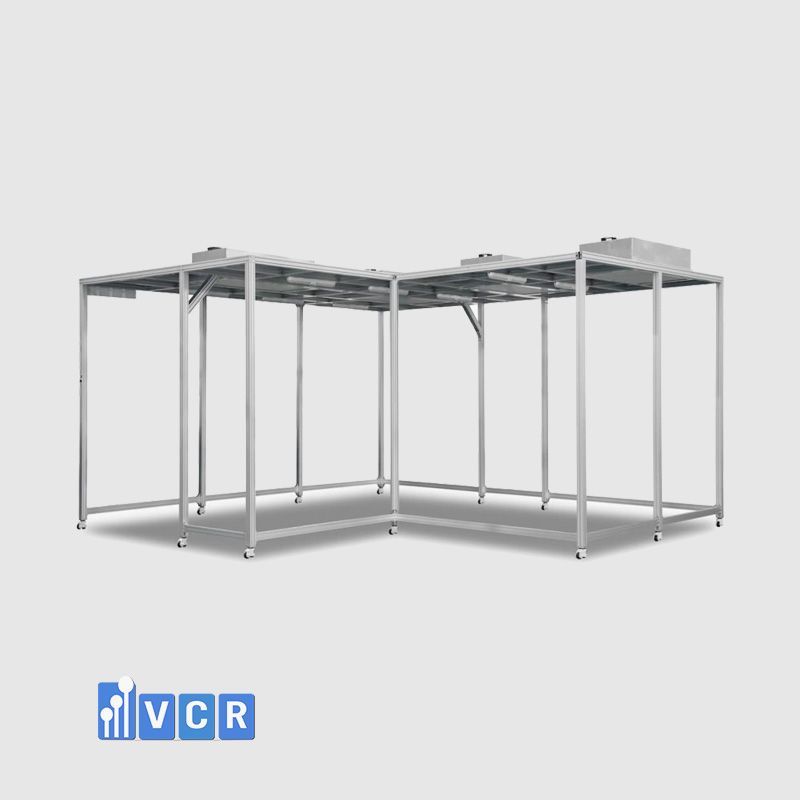
In real-world implementation, “Vietnam Cleanroom equipment VCR” observes that many companies aim for the highest ISO class under the assumption that “cleaner is always better.” However, cleanroom design is not about achieving the lowest possible ISO level, but about matching cleanliness to process requirements. ISO 5 is a very high standard, typically used in semiconductor or ultra-sensitive processes. Applying it across an entire electronics facility—especially SMT, PCB, and assembly areas—results in significantly higher costs without proportional improvements in quality.
What is ISO 5 and its technical requirements?
ISO 5, according to ISO 14644, allows extremely low particle concentrations, for example around 3,520 particles/m³ at 0.5 µm. Achieving this level requires laminar airflow, very high FFU density (often 60–100% ceiling coverage), and high-efficiency HEPA or ULPA filtration. The environment must also be highly stable, with minimal disturbance and strict control of contamination sources. ISO 5 represents not just a cleanliness level but a fundamentally different operational system.
Core issue: Not all areas require ISO 5
In a typical electronics factory, different areas have different sensitivity levels:
- Micro-scale processes (coating, lithography): extremely sensitive → ISO 5 required
- SMT and assembly: moderate sensitivity → ISO 7–8 sufficient
- Logistics and packaging: low sensitivity → no cleanroom or low-level control
Applying ISO 5 everywhere is equivalent to using high-precision tools for all tasks—technically effective but economically inefficient.
Impact on HVAC system design
ISO 5 requires very high air change rates (ACH), leading to:
- Increased fan capacity
- Higher cooling loads
- More complex ducting and air handling systems
This significantly increases both capital (CAPEX) and operational (OPEX) costs. A full ISO 5 facility may consume several times more energy than a properly zoned design.
Airflow challenges at large scale
ISO 5 requires uniform laminar airflow with minimal turbulence. Maintaining this across large areas is extremely difficult. Any disturbance can reduce system effectiveness. Therefore, ISO 5 is typically applied only in localized critical zones.
Airtightness and leakage risks
At ISO 5, airtightness is critical. Expanding ISO 5 across an entire facility increases:
- Number of penetrations (cables, pipes)
- Risk of leakage
- Difficulty maintaining stable pressure
Even small leaks can destabilize the system due to high airflow rates.
Pressure cascade complexity
ISO 5 environments require precise pressure control. When applied across an entire facility, it becomes difficult to create effective pressure cascades because buffer zones are eliminated. This reduces contamination control effectiveness.
Impact on personnel and operations
ISO 5 requires strict gowning, limited movement, and controlled behavior. Applying this across all areas can:
- Reduce productivity
- Increase training and operational costs
- Still not eliminate human-generated particles
Energy consumption – the dominant factor
ISO 5 environments require continuous high airflow and filtration, leading to very high energy consumption. This is a long-term cost that significantly impacts overall operational expenses.
Common misconception: Higher ISO equals better quality
Higher ISO levels only improve quality when particle contamination is the root cause of defects. If defects are caused by ESD, humidity, or process variation, upgrading ISO class will not solve the problem.
Impact on yield
ISO 5 improves yield only in particle-sensitive processes. In typical SMT or PCB manufacturing, the benefit is limited because defects are often driven by other factors.
Optimal solution: Cleanroom zoning strategy
The most effective approach is zoning:
- ISO 5: critical processes (coating, wafer, OLED)
- ISO 6–7: main production
- ISO 7–8: support areas
- Non-cleanroom: storage and logistics
This approach reduces cost while maintaining effective contamination control where needed.
When should ISO 5 be expanded?
ISO 5 should only be expanded when:
- Data confirms particles are the main limiting factor
- Customer requirements demand higher standards
- Production shifts to high-end applications
Even then, expansion should be localized rather than facility-wide.
Strategic perspective: Cleanroom as a technical–economic system
Cleanroom design is not about achieving the highest cleanliness level but about maximizing return on investment. A stable ISO 7 system often delivers better performance than an unstable, high-cost ISO 5 system.
Conclusion: Should ISO 5 be used for an entire electronics factory?
No. ISO 5 should only be applied to highly critical areas. A zoned cleanroom design is the most effective strategy to balance cost, performance, and operational efficiency.
Duong VCR