- What is an Air Shower and how does it actually work?
- Is an Air Shower truly necessary in electronics cleanrooms?
- How effective is an Air Shower in particle reduction?
- How does an Air Shower affect airflow and pressure cascade?
- Can an Air Shower control AMC?
- Can Air Showers replace gowning procedures?
- Impact of Air Shower on operational efficiency
- Common mistakes in Air Shower usage
- Maintenance requirements and risks
- Impact on yield and production performance
- Cost and return on investment
- When should Air Showers be used?
- When should Air Showers not be used?
- Conclusion: Are Air Showers necessary?
In real-world implementation, “Vietnam Cleanroom equipment VCR” observes that Air Showers are among the most misunderstood devices in electronics cleanrooms. Some facilities treat them as mandatory, while many advanced semiconductor fabs eliminate them entirely. This difference is not about the device itself, but about understanding contamination sources and control strategies. An Air Shower is not a “complete cleaning solution,” but a pre-entry particle reduction layer. If misapplied, it becomes unnecessary cost; if properly integrated, it can improve real cleanliness performance.
What is an Air Shower and how does it actually work?
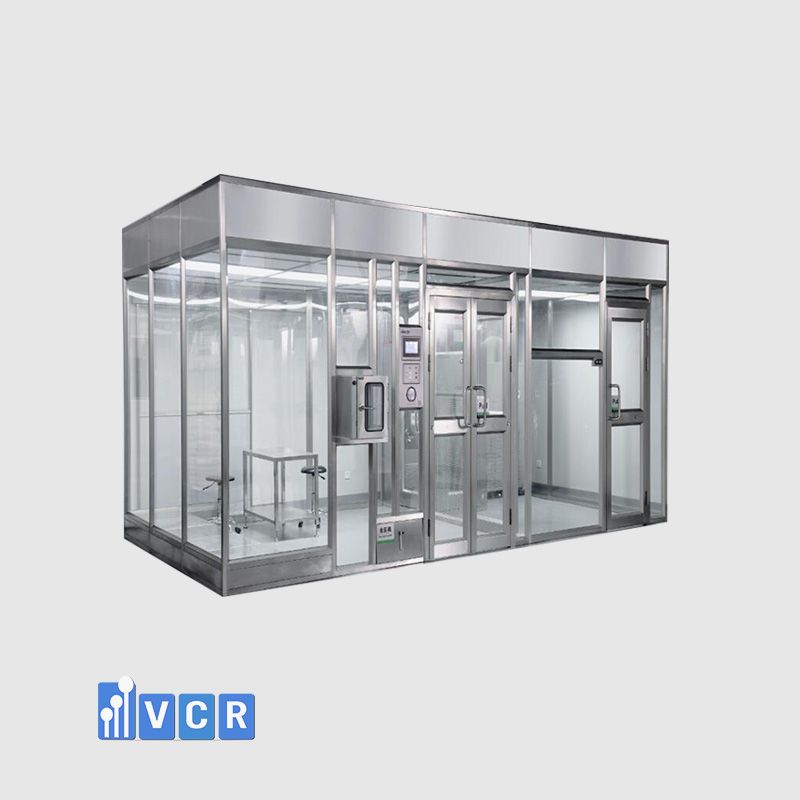
An Air Shower is an enclosed chamber installed at cleanroom entry points, using high-velocity air jets (typically 20–30 m/s) to dislodge particles from clothing, skin, or materials. The air is recirculated through HEPA filters to maintain cleanliness. However, the mechanism only removes loosely attached particles, not those embedded in fabric or tightly adhered. Effectiveness also depends heavily on user behavior—if personnel do not rotate or position themselves correctly, performance drops significantly. Therefore, an Air Shower is not a standalone solution but part of a broader contamination control system.
Is an Air Shower truly necessary in electronics cleanrooms?
The answer depends on the application. In mid-level cleanrooms (ISO Class 7–8), where personnel are a major contamination source, Air Showers can significantly reduce incoming particle load. However, in advanced semiconductor fabs (ISO Class 5 and above), where gowning protocols and airflow systems are highly optimized, Air Showers often provide limited additional benefit. In such environments, contamination is more likely driven by AMC or internal processes rather than external particles. Therefore, Air Showers are not universally required but should be evaluated based on system design and process needs.
How effective is an Air Shower in particle reduction?
Under ideal conditions, Air Showers can remove a significant portion of loose surface particles. However, real-world effectiveness is often lower due to improper usage and already low contamination levels after proper gowning. In well-controlled environments, the marginal benefit may be minimal. This highlights the importance of evaluating Air Shower performance using actual particle data rather than theoretical assumptions.
How does an Air Shower affect airflow and pressure cascade?
Air Showers often function as airlocks, reducing direct air exchange between external areas and cleanrooms. Properly designed, they help maintain positive pressure and reduce airflow disturbance. However, poor design or incorrect operation can introduce turbulence and disrupt pressure balance. Integration with HVAC and cleanroom layout is essential.
Can an Air Shower control AMC?
No. Air Showers only affect particles and have no impact on airborne molecular contamination (AMC). This is a critical limitation, especially in modern semiconductor cleanrooms where AMC control is increasingly important.
Can Air Showers replace gowning procedures?
No. Gowning is the primary contamination control method, preventing particle generation at the source. Air Showers are only a supplementary step. Improving gowning procedures is generally more effective than relying on Air Showers.
Impact of Air Shower on operational efficiency
Air Showers introduce additional entry time, typically 10–30 seconds per cycle. In facilities with high personnel traffic, this can create bottlenecks and reduce operational efficiency. Proper sizing and layout are necessary to minimize delays.
Common mistakes in Air Shower usage
The most common mistake is treating Air Showers as the main contamination control method. Other issues include lack of user training, improper operation, and failure to evaluate effectiveness. Installing Air Showers without performance validation often leads to unnecessary investment.
Maintenance requirements and risks
Air Showers require regular maintenance, including HEPA filter replacement, nozzle inspection, and chamber cleaning. Poor maintenance can turn the unit into a contamination source rather than a control device.
Impact on yield and production performance
In moderate cleanroom environments, Air Showers can reduce particle ingress and improve yield. However, in advanced fabs, their impact is relatively small compared to airflow design, AMC control, and process stability.
Cost and return on investment
While initial investment is moderate, operational costs (energy, maintenance, time) must be considered. ROI depends on measurable contamination reduction. Without data, investment may not be justified.
When should Air Showers be used?
Air Showers are suitable when:
- High personnel traffic exists
- Gowning is not fully optimized
- Cleanliness requirements are moderate
In these cases, they help reduce incoming particle load.
When should Air Showers not be used?
In highly advanced semiconductor cleanrooms with optimized contamination control, Air Showers may be unnecessary. Without proper operational discipline, they provide little benefit.
Conclusion: Are Air Showers necessary?
Air Showers are not universally required in electronics cleanrooms. Their value depends on how well they are integrated into the overall contamination control strategy. Modern cleanrooms must rely on a combination of gowning, airflow control, filtration, and AMC management rather than a single device.
Duong VCR